Thursday, June 15, 2023
What did Louis IX look like?
Medieval Swords
\
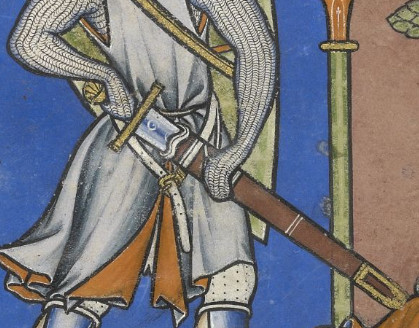
Detail of a sword being drawn from its scabbard, Morgan Bible fol. 28v, c. 1250.
So, it turns out not only are rapiers not options for my early 13th century characters, but so are longswords--but that's good news, as the knightly arming sword that was in use at the time, is just what the story needs:
"a straight, double-edged weapon with a single-handed, cruciform (i.e., cross-shaped) hilt and a blade length of about 70 to 80 centimetres (28 to 31 in)." (C.f. above link to straightforward wikipedia page).
And Renaissance and following ages' innovations notwithstanding, apparently people are still interested in this kind of weapon, and have provided interesting feedback on how it works as a wepaon (or at least how a modern replica feels to a swordsman).
Monday, April 10, 2023
Medieval Music
Miniature (illuminated manuscript) from: Liber choralis parvus continens missas vesperas et alia officia par S. Leonardi confes
Interesting Composer who would be fun to have cameo in first half of 13th century setting (i.e. wip):
Medeival music with Manuscripts
Farya Faraji -- not just medieval, but over all fascinating discussions of historically accurate performance, (though the following is close enough for current wip:)
Sunday, January 22, 2023
Palais de la Cite, Paris
http://projects.mcah.columbia.edu/medieval-architecture/htm/related/ma_paris_palais_cite_01.htm
Also, these 3d explorations of medieval Paris:
Thursday, January 19, 2023
Dragons in Ancient and Medieval literature
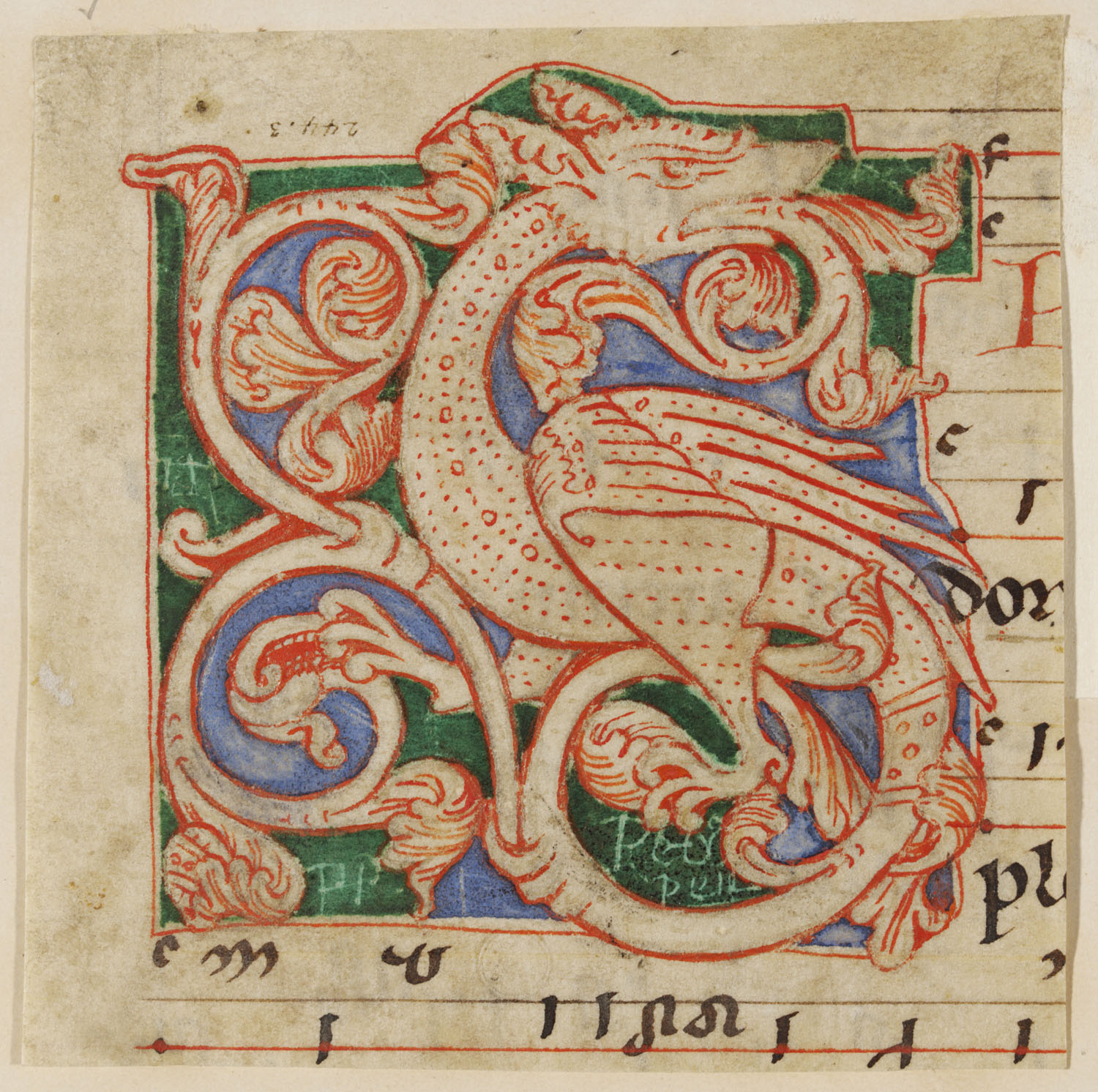
244:3, Leaf from choir-book with initial S in red pen-work on green and blue ground depicting a dragon. Netherland. late 12th century, © V&A Museum
https://www.vam.ac.uk/blog/museum-life/here-be-dragons-2
So, I have a character in 13th century France, who, like his contemporaries, thought dragons were all very well in illuminations and such, (like the above), and for making moral and allegorical points--but as living creatures, they might be considered as exotic, remote, and belonging principally to the past.
Until one shows up in his life. Then he turns to old books for answers.
But what would he have found historically? Some interesting stuff, actually, in ancient bestiaries: https://bestiary.ca/beasts/beast262.htm
While the ancient sources included many fanciful details, even as they sought to be factual and comprehensive, their medieval successors had different aims, viewing the genre as an opportunity for making moral observations. Hence the solid association of the dragon with the devil, combining biblical sources with the ancient descriptions in these bestiary entries (such as those found in the Aberdeen Bestiary and many others).
For more information, and a fascinating overview article on dragons in the minds of Western peoples across the centuries:
Also, I skimmed through this article, which got me tracking in the right direction about bestiaries:
Sunday, October 9, 2022
Tracking medieval titles and nobility
The title of a knight is Chevalier. A lesser Knight, ( eg son of a knight) is an Écuyer .
The title comes after the name when y whole name.
Eg “Richard de Longeville, Chevalier”
Or “Jean de Longeville, Écuyer”
To be a Chevalier, you had to be a member of an “Order of Knights”
When speaking to a Knight, he would be addressed as “Mon Seigneur” (My Lord)
From which derives the modern day word Monsieur.
There were other titles for Knights who had land posessions;
Duc, Prince, Baron, Marquis. Compte. Viscompte
In English , Seigneur became anglicised into “Sir”
Friday, September 23, 2022
Swords and strategy
You want the details in action to be relevant and right, so I was doublechecking the kinds of sounds swords make (when drawn, when clashing, etc.) and found this neat article in The Scientific American:
The Science of Swords: The Sound of Approaching Doom
Fascinating stuff, considering swords of various types, aerodynamics, and slicing technique among other things.